When Should We Consult an Infertility Specialist, and What Tests Do Both Partners Need?
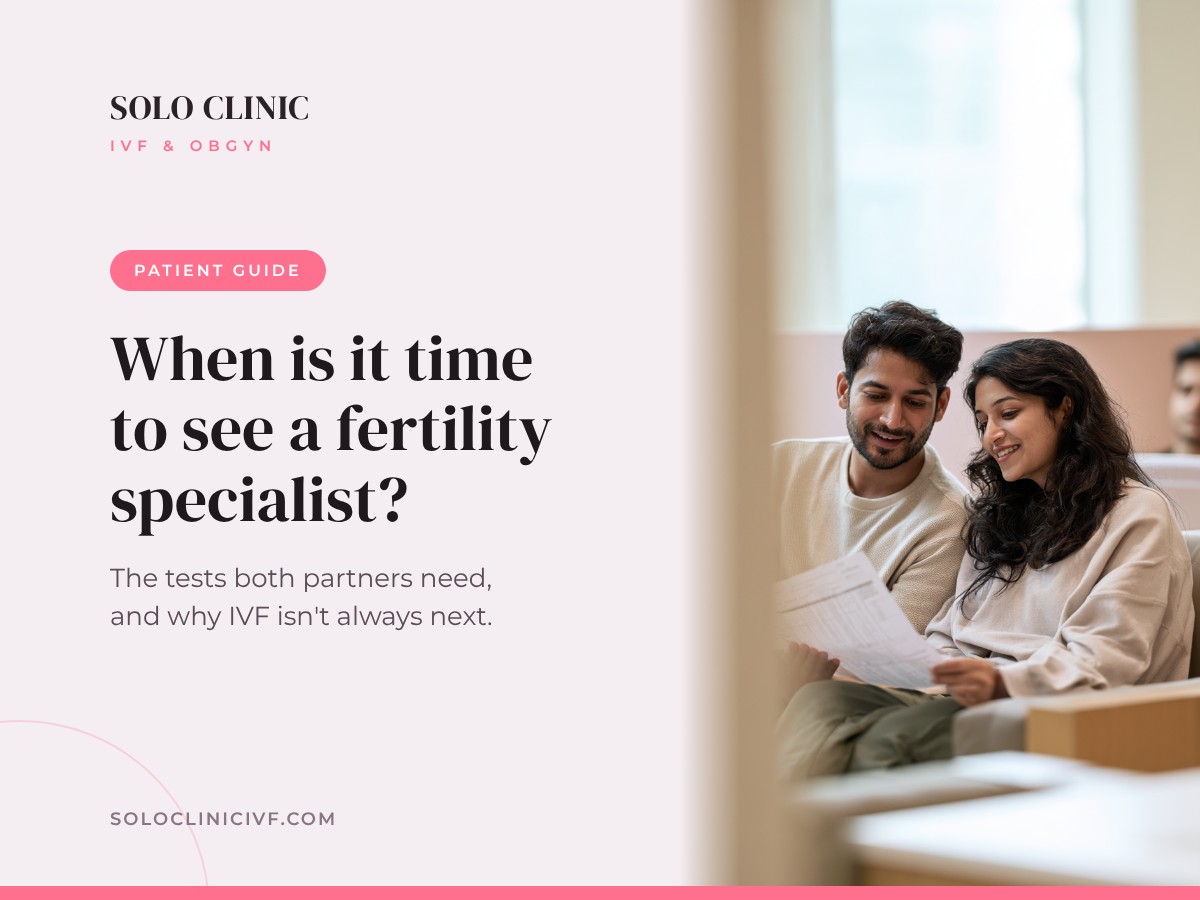
Learn when to seek infertility evaluation, which tests both partners may need, and why not every couple requires IVF.
When should you seek help?
Couples often wait longer than necessary because they are unsure when difficulty conceiving becomes a reason to seek medical advice. For couples having regular unprotected intercourse without a known infertility condition, evaluation is generally advised after 12 months when the woman is younger than 35, and after six months at age 35 or older. Women older than 40 may benefit from prompt assessment. These are starting points, not rules that should delay care for someone with a known problem.
If you are unsure which specialist to see first, read which doctor should I consult for infertility.
When should the evaluation begin sooner?
Do not wait for a fixed number of months when there are irregular or absent periods, known or suspected endometriosis, previous pelvic infection or tubal disease, ovarian surgery, recurrent pregnancy loss, a known sperm problem, or treatment that may affect fertility. Age, pain, past operations and the couple's plans all change the urgency. The first visit should help decide which investigations can genuinely influence treatment.
Why are both partners assessed?
A fertility evaluation should not be a series of tests performed only on the woman. Where a male partner contributes sperm, a semen analysis and reproductive history are important early steps, conducted alongside the female assessment. Semen parameters can fluctuate, so an abnormal result often needs appropriate confirmation and sometimes specialist andrology or urology review. A normal semen analysis also does not exclude every possible male factor, but it helps identify the best next step. See also sperm DNA fragmentation testing.
What tests are commonly considered for the woman?
The consultation starts with menstrual and pregnancy history, prior procedures, symptoms, and review of relevant medical conditions. Ultrasound can identify uterine or ovarian abnormalities. Tubal patency may be assessed with hysterosalpingography (HSG) or a contrast-ultrasound technique (HyCoSy) when appropriate.
Hormone tests are directed by the clinical history. AMH and antral follicle count help estimate ovarian response to stimulation; they are not reliable stand-alone tests of the ability to conceive naturally. Read more: Low AMH and fertility: what it really means for your chances.
Which tests are not automatic?
A routine diagnostic laparoscopy, hysteroscopy, advanced sperm-function test, thyroid profile, prolactin test or complex immune panel is not necessary for everyone. An investigation should answer a specific question or change the management plan. Repeating the same test without a reason increases cost and anxiety rather than necessarily improving the chance of pregnancy.
What happens after the results?
The aim is to identify whether the main issue involves ovulation, sperm, tubes, uterus, pelvic disease, age-related factors or a combination. The appropriate plan could be timed intercourse, ovulation induction, IUI, surgery, IVF/ICSI, or further counselling.
A careful specialist should explain alternatives, realistic outcomes, costs and a time frame for review. It is entirely reasonable to request copies of results and seek a second opinion for a complicated case. For complex cases, see how to choose an IVF consultant for complex infertility.
Frequently Asked Questions
Do we both need to attend the first appointment?
If possible, yes. Parallel evaluation usually saves time and makes shared decisions easier.
Does a low AMH result mean IVF is immediately necessary?
No. AMH helps estimate response to stimulation and must be interpreted with age, ultrasound and the full fertility history.
Will every couple need laparoscopy?
No. Laparoscopy is usually reserved for suspected pelvic disease or another clear surgical indication. Learn more about laparoscopy for infertility.
About the Expert
Dr. Sunita Rajesh Tandulwadkar is a Pune-based gynaecological endoscopic surgeon and IVF consultant; President, Indian Society of Assisted Reproduction (2026–2028), and 63rd President of FOGSI (2025). Her clinical work integrates reproductive surgery, assisted reproduction and complex fertility care.
References
- ASRM, Fertility Evaluation of Infertile Women (2026)
- AUA/ASRM, Diagnosis and Treatment of Infertility in Men (2024 amendment)
No outcome is guaranteed. Content is educational and not a substitute for individual consultation.